

Home | Site Map | Search | Contact Us

IRC Study Estimates 14% of Drivers Are Uninsured

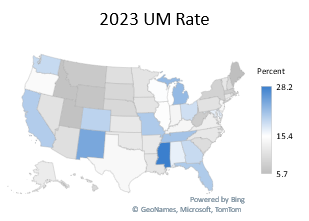
MALVERN, Pa.—The chances are about 14 in 100 that, if an insured car occupant is injured in an auto accident in the U.S., an uninsured motorist caused the accident, according to a recent Insurance Research Council (IRC) study. However, the problem varies widely from state to state (see attached map). Uninsured Motorists 2000 Edition, an update to a previous IRC study examining the uninsured motorist problem, contains two additional years of the latest available data.

According to data just released (for the period of 1995 to 1997), the five states with the highest uninsured driver estimates were Colorado (32%), New Mexico (30%), South Carolina (28%), Alabama (25%), and Mississippi (25%). (Colorado’s estimate is high relative to other states, however, because bodily injury claims are subject to a $2,500 monetary threshold and uninsured motorist claims are not. In other states, the thresholds are the same.) The five states with the lowest uninsured driver estimates were Maine (4%), North Carolina (6%), South Dakota (6%), Massachusetts (7%), and Wyoming (7%). Sixteen states and the District of Columbia had a ratio of uninsured motorists to bodily injury claim frequencies above the national average, while thirty-four states had a ratio below the national average. A complete listing of the estimated percentage of uninsured motorists in each state is provided at the end of this press release.

"Despite laws in many states requiring drivers to maintain insurance, about one in seven motorists remain uninsured," according to Elizabeth Sprinkel, senior vice president, who heads the IRC. "This means that responsible drivers who carry insurance must bear the burden of paying for injuries caused by drivers who carry no insurance at all."

The study contains the most recent state statistics on uninsured motorist claim frequency, bodily injury claim frequency, and the ratio of uninsured motorist to bodily injury claim frequencies. IRC calculates the uninsured driver proportion using a ratio of claims made by individuals injured by uninsured drivers (uninsured motorists coverage) to claims made by individuals injured by insured drivers (bodily injury liability coverage).

IRC used claims data compiled by the National Association of Independent Insurers; Insurance Services Office, Inc.; National Independent Statistical Service; Maryland Automobile Insurance Fund; Automobile Insurers Bureau of Massachusetts; Texas Department of Insurance; and South Carolina Department of Insurance to derive its findings.

Percentage of Uninsured Motorists State by State

Source: Insurance Research Council, based on data from 1995-1997.
Colorado’s estimate is inflated because bodily injury claims are subject to a $2,500 threshold and uninsured motorist claims are not. In other states, the thresholds are the

Percentage of Uninsured Motorists
1995 - 1997 Average
State Percent
Uninsured
  State Percent
Uninsured
Colorado 32%   Rhode Island 11%
New Mexico 30%   Delaware 11%
South Carolina 28%   Arkansas 11%
Alabama 25%   Wisconsin 11%
Mississippi 25%   Hawaii 10%
California 22%   Kentucky 10%
District of Columbia 21%   Iowa 10%
Florida 20%   Pennsylvania 9%
Texas 18%   Vermont 9%
Tennessee 18%   Montana 9%
Oklahoma 17%   Connecticut 9%
Alaska 16%   Kansas 9%
Maryland 16%   Utah 9%
Arizona 16%   New Hampshire 9%
Nevada 15%   Louisiana 8%
New Jersey 15%   West Virginia 8%
Washington 15%   Idaho 8%
Missouri 13%   New York 7%
Georgia 13%   North Dakota 7%
Michigan 13%   Nebraska 7%
Illinois 13%   Wyoming 7%
Ohio 13%   Massachusetts 7%
Oregon 12%   South Dakota 6%
Virginia 12%   North Carolina 6%
Indiana 12%   Maine 4%
Minnesota 12%   Nationwide 14%

Note: IRC calculates the uninsured driver proportion using the ratio of claims made by individuals who were injured by uninsured drivers (uninsured motorists coverage) to claims made by individuals injured by insured drivers (bodily injury liability coverage). Colorado's estimate is inflated because bodily injury claims are subject to a $2,500 threshold and uninsured motorists claims are not. In other states, the thresholds are the same.

Source: National Association of Independent Insurers; Insurance Services Office, Inc.; National Independent Statistical Service; Maryland Automobile Insurance Fund; Automobile Insurers Bureau of Massachusetts; South Carolina Department of Insurance; and Texas Department of Insurance. Michigan and North Carolina 1996 and 1997 data from NAII are preliminary.